

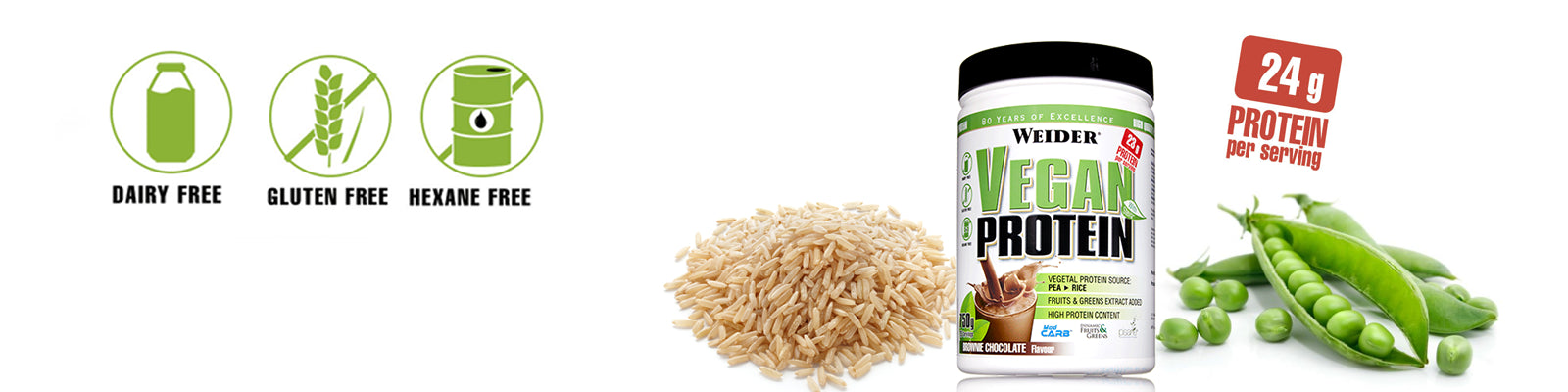

Do you know Vegan Protein, Weider's new protein?
Proteins are essential for maintaining optimal health and protecting muscle, but getting enough protein can often be difficult, especially for people with special needs such as vegetarians, vegans, or those with allergies or intolerances.
At Weider, we wanted to expand your options for enriching your diet with protein, but we weren't satisfied with a conventional plant-based protein. We wanted to offer you the best protein you can imagine: a complete protein made from high-quality pea protein and enriched with rice protein, antioxidants, and modCARB™.
But you don't need any special needs to enjoy Vegan Protein. If you simply like to take care of your health, are an athlete, or just want to balance the protein intake in your diet with a quality, safe, and environmentally friendly plant-based protein, don't hesitate—Vegan Protein from Weider is your protein!
Main characteristics of Vegan Protein:
- 100% Plant-based Protein, suitable for vegans.
- High protein content (76-81%)
- High digestibility and good tolerance.
- High biological value and rich in BCAAs and arginine.
- Low sugar content and no added sugars.
- Low fat and saturated fat content.
- Free of gluten, soy, dairy, lactose, and major allergens.
- Cholesterol-free.
- Suitable for vegans, vegetarians, and celiacs.
Plant-based Protein vs. Animal Protein
Generally, plant-based foods tend to contain less protein than animal-based foods, and probably for this reason, plant proteins are less known and less consumed. However, thanks to isolation and concentration processes, proteins can be extracted from plant foods to obtain products with a high protein content.
Likewise, plant proteins usually offer a smaller amount of essential amino acids than animal proteins, and for that reason, they are considered of lower quality. However, an adequate selection of the protein source can offer a complete and excellent quality aminogram, as is the case with pea protein, which is rich in essential and branched-chain amino acids. Vegan Protein is an easy way to balance the protein intake in your diet between plant-based and animal-based proteins!
Pea Protein (Pisane)
Essential amino acids determine the quality of protein, and specifically, branched-chain amino acids (BCAAs) are key to maintaining and developing muscle mass. Pea protein is a high biological value protein, meaning it provides a large number of essential amino acids; in addition to being rich in branched-chain amino acids (leucine, isoleucine, and valine). Furthermore, pea protein offers a high lysine content and a greater arginine supply than any dairy protein.
| Pisane pea protein covers virtually 100% of essential amino acid needs. | ||
| Essential Amino Acids | FAO/WHO Amino Acid Pattern | Pisane Pea Protein (g/100 protein) |
| Histidine | 1.5 | 2.5 |
| Isoleucine | 3.0 | 4.5 |
| Leucine | 5.9 | 8.4 |
| Lysine | 4.5 | 7.2 |
| Methionine + Cysteine | 2.2 | 2.1 |
| Phenylalanine + Tyrosine | 3.8 | 9.3 |
| Threonine | 2.3 | 3.9 |
| Tryptophan | 0.6 | 1.0 |
| Valine | 3.9 | 5.0 |
An important aspect to consider when choosing a protein is the rate at which its amino acids are released and absorbed. Pea protein has an intermediate absorption profile, meaning its amino acids stimulate protein synthesis while remaining elevated in the blood long enough to protect and develop muscle mass.
Pisane VS other pea proteins
The main protein in Vegan Protein Weider is Pisane pea protein isolate. Pisane C9 pea isolate contains 88% protein made from non-GMO peas grown in Europe. Its extraction uses exclusively physical processes, without chemical solvents such as hexane, which is used in the extraction of low-quality vegetable proteins.
The result of this exclusive Pisane process is a high-protein isolate with high digestibility and excellent tolerance. Pisane is rich in iron (15 mg/100 g) and is free of lactose, cholesterol, and major allergens such as gluten.
Plant-based foods are naturally rich in compounds called anti-nutrients such as alpha-galactosides, trypsin inhibitors, or phytic acid. These anti-nutrient compounds reduce the digestibility and nutritional value of plant proteins. Pisane, thanks to its exclusive manufacturing process, provides very low levels of these compounds.
Pisane vs Soy Protein
Until now, soy protein had been the main plant protein, but pea protein has made a strong entrance thanks to its excellent quality and digestibility. Pea protein is very well tolerated and has a very low allergenic potential. In fact, it is not included in the allergen list; while many people cannot consume soy protein because it is highly allergenic.
Plant proteins like those from soy contain isoflavones, also known as phytoestrogens, which cannot be consumed in large quantities by some people. Pisane pea protein is so low in isoflavones that its content is practically undetectable. Another important aspect to consider is that soy protein is often obtained with solvents and comes from genetically modified soybeans.
Vegan Protein Ingredients
Whole grain rice protein
You've probably heard that combining legumes with rice offers a high biological value protein.
Rice protein complements the excellent aminogram of pea protein.
In Vegan Protein, it comes from organic, non-GMO whole grain rice, has good digestibility, and offers an excellent amino acid profile that is also released at an average rate.
It is a source of fiber and minerals such as calcium and iron; while being naturally free of gluten and cholesterol.
Like pea protein, it is low in isoflavones and, of course, suitable for vegetarians and vegans.
ModCARB™
A next-generation ingredient made from healthy grains (oat bran, organic amaranth, organic buckwheat, organic chia, organic millet, and organic quinoa). This combination helps regulate glucose absorption and metabolism, helping to prevent sweet cravings and energy crashes. ModCARB™ improves nutrient bioavailability while providing nutrients such as amino acids and functional components like beta-glucans. ModCARB™ also gives Vegan Protein a creamy and delicious texture that makes taking your plant-based protein a much more appetizing experience. Although ModCARB is made with cereals, it is completely gluten-free.
Dynamic Fruits&Greens
Concentrated extract of fruits and vegetables that provide nutrients and antioxidant substances that help maintain health. Some of the ingredients you can find in this blend are paprika, ginger, broccoli, spinach, cabbage, green tea, raspberry... Dynamic Fruits&Greens is free of all types of allergens and GMOs (genetically modified organisms).
Natural ingredients
In the formulation of Vegan Protein, the use of natural ingredients has been prioritized. For example, cocoa powder, turmeric as a coloring agent, and sweeteners from the Stevia leaf have been used. Stevia is the only natural sweetener as it comes from the Stevia plant whose glycosides provide a sweet taste without providing calories.
Vegan protein, perfect as a post-workout supplement
Pea protein, thanks to its excellent aminogram and absorption profile, can be perfectly used as a post-workout protein. Each dose of Vegan Protein provides up to 4.35 grams of BCAAs, 7.62 grams of essential amino acids, as well as conditionally essential amino acids such as arginine (2.1 grams) and histidine (0.6 grams).
It has always been said that whey protein is the best post-workout protein, but now there is an equally effective plant-based alternative for recovery. In fact, a recent study found no differences between consuming whey protein or pea protein after strength training.
| Aminogram Vegan protein Vanilla Flavor | Whey Protein | |
| Alanine | 3.5 g | 4.1 g |
| Arginine | 7.0 g | 2.1 g |
| Aspartic Acid | 9.2 g | 8.7 g |
| Cysteine | 0.8 g | 1.9 g |
| Glutamic Acid | 13.6 g | 13.9 g |
| Glycine | 3.3 g | 1.5 g |
| Histidine | 2.0 g | 1.5 g |
| Tryptophan | 0.8 g | 1.5 g |
| Isoleucine | 3.6 g | 4.9 g |
| Leucine | 3.6 g | 4.9 g |
| Lysine | 5.7 g | 7.2 g |
| Methionine | 0.9 g | 1.6 g |
| Phenylalanine | 4.4 g | 2.6 g |
| Proline | 3.6 g | 4.7 g |
| Serine | 4.3 g | 4.2 g |
| Threonine | 3.2 g | 5.7 g |
| Tyrosine | 3.1 g | 2.8 g |
| Valine | 4.1 g | 4.6 g |
Environmentally friendly
Finally, for those who, in addition to their diet, care about environmental protection, they will be delighted to know that by consuming Vegan Protein from Weider, they will be contributing to caring for the planet. Plant-based proteins are more environmentally friendly, require fewer resources to produce, and generate fewer greenhouse gas emissions like methane or CO2 during production. Furthermore, Pisane has a much smaller carbon footprint than any other pea protein because its manufacturing does not use solvents or fertilizers, and since it is grown in Europe, the CO2 emissions from transportation are reduced.
References:
· Babault et al. Pea proteins oral supplementation promotes muscle thickness gains during resistance training: a double-blind, randomized placebo-controlled clinical trial vs whey protein. Journal of the International Society of Sports Nutrition (2005) 12:3.
· www.pisane-cosucra.com
Compartir:
Force Protein 1st Anniversary Party
Official Championship of the Community of Madrid