

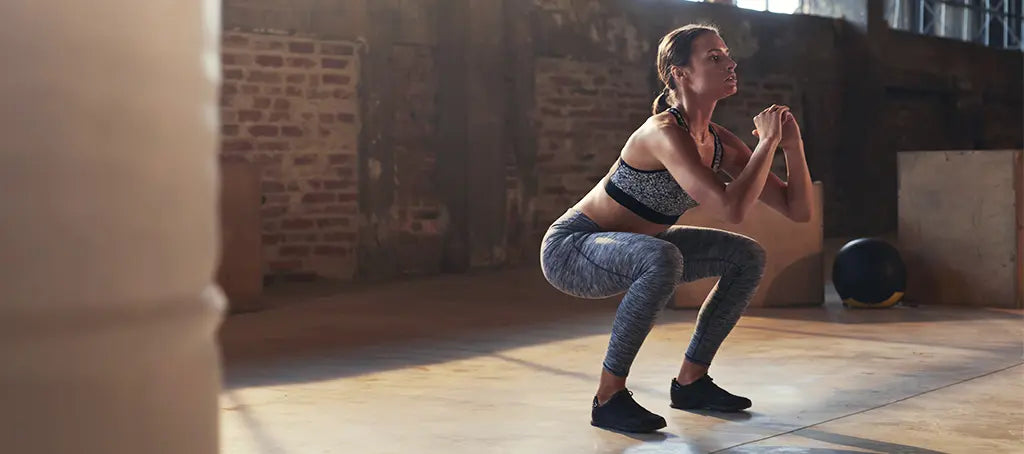
Have you ever watched a child, for example, when they stoop to pick up a toy from the floor? They perform a TECHNICALLY PERFECT squat, much more correct than 95% of those of us who go to the gym to train glutes.
Innately, a child correctly uses their glutes in their movement patterns, and that's why the muscles in that area are still naturally strong and toned. Unfortunately, due to bad habits and the sedentary lifestyle adults lead, the gluteal muscles tend to deactivate, becoming lazy. Working sitting all day, watching television, driving from one place to another... these are some of the reasons why the glutes atrophy and stop "functioning" correctly.
Benefits of having strong and toned glutes
Yes, yes, FUNCTION, because it's not just a matter of aesthetics, THE GLUTES PERFORM VERY IMPORTANT FUNCTIONS when it comes to mobility and physical well-being.
The glutes are a group of muscles that give us mobility and stability to the pelvis (they keep us upright), and consist of three parts:
- Gluteus Maximus. – It is a very powerful muscle and its function is hip extension (moving the leg backward) and external rotation.
- Gluteus Medius. – Its function is hip abduction or moving the leg away from the midline of our body.
- Gluteus Minimus. – Same function as the gluteus medius.
AND WHY IS IT SO IMPORTANT TO WORK OUR GLUTES?
Especially women, we obsess over this area for purely aesthetic reasons, but in reality, MEN AND WOMEN SHOULD NOT NEGLECT THIS IMPORTANT AREA. And yes... we will also significantly improve our figure aesthetically.
If we don't work the glutes properly, other muscular structures activate to substitute their function: lumbar, hamstrings (biceps femoris, semitendinosus, and semimembranosus), and quadriceps. This logically triggers discomfort, injuries, or chronic pain.
- When we specifically work the muscles, we can improve and make these discomforts disappear, such as lower back pain, knee pain, hip pain, or minimize the risk of muscle tears in the posterior chain (hamstrings).
- Properly training the glutes also prevents nerve pain (sciatica) and we will have greater trunk stability (CORE), which will reduce the risk of developing herniated discs.
SOME TIPS TO ACTIVATE AND TRAIN YOUR GLUTES CORRECTLY:
As we have mentioned, poorly toned or "inactive" glutes are more than an aesthetic issue; it is A HEALTH ISSUE. If the glutes are not functioning efficiently, other muscles or areas will be trying to compensate, thereby causing possible overloads, discomforts, and problems that can lead to more serious injuries.
-
Get rid of sedentary habits. – One of the simplest ways to start "awakening" your gluteal muscles is to MOVE MORE!
- Climb stairs, hills, and inclines
- Try to walk more often
- Work standing (if you can afford it) or on a Fitball (increases the work of stabilizing muscles).
- Stretch more (especially the iliopsoas)
-
Do specific exercises to tone and activate the glutes, such as:
- Lunges
- Lateral and rear leg raises
- Lateral hip abductions
- Lateral steps with a resistance band
- Bridge or hip extension on the floor (without weight, just squeeze and concentrate the muscle)
- Once the glute is "awake," we start with strength exercises and adding weight loads:
- Neutral position squats
- Sumo squats
- Bulgarian split squats
- Lunges with weight (preferably walking lunges)
- Box step-ups with weight
- Deadlifts
- Hip Thrust or weighted hip extension
- Be very careful with the TECHNIQUE in all these exercises; your back should not hurt. Knees... start with a weight you can control and gradually increase it.

Compartir:
Eating Almonds, the Nuts Every Athlete Needs
Taking Vegan Protein is Good, Even if You're Not Vegan