

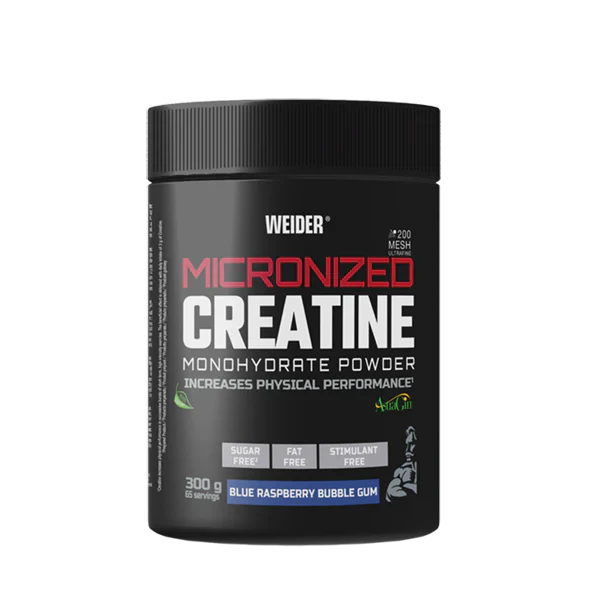

In 2025, the most commonly used types of creatine are monohydrate, HCl (hydrochloride), Kre-Alkalyn, and creatine ethyl ester. Creatine monohydrate remains the most studied, effective, and recommended due to its safety, affordable price, and scientific backing.
Choosing the right type of creatine can make a big difference in your performance and supplementation experience. Although all have the same goal: to increase muscle phosphocreatine levels to improve energy production, each format has distinct characteristics in terms of absorption, dosage, or digestive tolerance.
Types of Creatine
1. Creatine monohydrate
The most well-known, studied, and effective. It offers excellent value for money and works for most people. It is usually available in powder form, unflavored or with pleasant options such as watermelon, cherry, or lollipop. It is the most widely used form by both beginners and advanced athletes, as decades of studies support its effectiveness. Ideal for those seeking proven results without complications.

Advantages: Highly effective, affordable, scientific backing.
Disadvantages: May not work well if not consistent or if proper hydration is not maintained throughout the day.
2. Creatine HCl (hydrochloride)
It dissolves better in water and is less likely to cause digestive discomfort, making it attractive for people with sensitive stomachs. Being more concentrated, a lower dose is required compared to monohydrate. It is an interesting option for those looking to reduce intake volume and improve solubility without sacrificing effectiveness.
Advantages: High solubility, lower doses, good tolerance.
Disadvantages: Higher price and less scientific backing compared to monohydrate.
3. Kre-Alkalyn
An alkaline version designed to improve stability in acidic environments such as the stomach. It is promoted as a form that does not require a loading phase or cause water retention. Although attractive due to its ease of use, available studies have not shown clear improvements over other variants.
Advantages: Good tolerance, convenient, does not require a loading phase.
Disadvantages: Limited scientific evidence, higher cost.
4. Creatine ethyl ester
For a time, it was considered an innovation due to its supposed greater cellular absorption. However, subsequent research showed that much of this type rapidly converts to creatinine, which can reduce its benefits. Currently, its use has decreased compared to more effective options.
Advantages: Innovative presentation, initially promising.
Disadvantages: Lower stability, questioned effectiveness in recent studies.
5. Other forms: citrate, malate, and magnesium-chelated
These types of creatine combine with other molecules with the intention of improving absorption, adding additional benefits, or facilitating digestion. They are mainly found in advanced formulas or multi-component products. Although they may have their place in certain contexts, they have not been shown to provide substantial improvements over the traditional monohydrate version.
Which to choose in 2025?
For most users, creatine monohydrate remains the best option. It is safe, economical, effective, and has decades of studies supporting its use. Alternative versions may be useful in cases of intolerance, personal preferences, or specific needs, but they have not proven to be generally superior.
If you are looking for a reliable supplement with guaranteed purity, always opt for recognized brands that offer quality analyses and a variety of formats. The key is consistency, the right dose, and choosing a formula that fits your daily routine.
Conclusion
In a market with an increasing number of creatine types, it's easy to get confused between formats. However, if you are looking for proven effectiveness, the smartest choice is still to opt for a quality creatine monohydrate, such as that offered by Weider, with guaranteed purity and available in flavored and unflavored formats to adapt to your daily life.

Compartir:
How can I tell if I have prostate problems?
Benefits of creatine according to scientific studies