

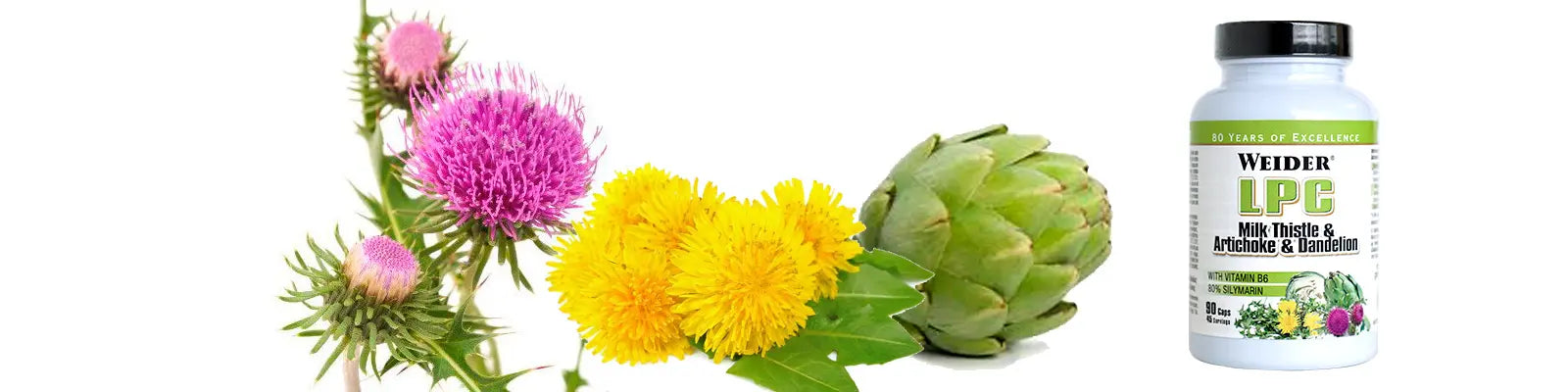

A trustworthy product for protecting our liver.
In the world of sports and athletic performance, sports supplementation plays a very important role. There are anabolic, anti-catabolic products that improve cellular oxygenation, that help to reduce body fat percentage... but we must not forget products that have a detoxifying action.
Every day we accumulate toxins mainly from the food we consume, as these often contain components of different origins to achieve better preservation, or better color, taste, smell, etc. preservatives, stabilizers... are common. In addition, some foods are processed, and even more so, some foods are genetically modified at their origin. The liver is where all these substances are processed.
Undoubtedly, LPC is a trustworthy product for protecting our liver.
Milk Thistle:
- The dried fruit is used.
- The main components or active ingredients are: silymarin (1-3%), flavonoids, quercetin, taxifolin.
- Due to the active ingredients of Milk Thistle, it has a hepatoprotective or antihepatotoxic action. It regulates cell membrane permeability and stimulates liver regeneration. This is because it has shown an antagonistic action against hepatotoxic substances. There is a modification of the liver cell membrane (hepatocyte) preventing toxic agents from penetrating. It also has an antioxidant and free radical scavenging action, mainly at the level of oxygen species (ROS) and peroxidation. It also has a slight anti-inflammatory action.
- According to Commission E (German Ministry of Health's expert committee), it can be used in situations involving digestive disorders (meteorism, flatulence, etc.), in liver diseases, including alcoholic intoxication, and liver inflammation.
- As side effects, it may exceptionally present a slight laxative action.
Dandelion:
- Both the leaves and the root are used.
- The main components are sesquiterpene lactones (germacranolide and eudesmanolide), triterpenes, sterols, and inulin.
- Due to its components, it has a choleretic and cholagogue action (from the Dandelion root) and a diuretic action from the leaves.
- According to ESCOP (European Scientific Cooperative on Phytotherapy), the therapeutic indication of dandelion would be for the stimulation of liver and biliary function, dyspepsia, and increased diuresis. According to Commission E, it is a purifying plant and a mild laxative.
Artichoke
- The dried leaves are used.
- The main components are phenolic acids (caffeoylquinic, etc.), flavonoids, sesquiterpene lactones, and organic fatty acids (quinic, citric, glyceride, etc.).
- The main pharmacological actions are related to processes involved in digestion. Various studies suggest hypocholesterolemic effects. It also has a hepatoprotective action.
- According to Commission E, the indication for this plant would be for dyspeptic problems, reduction of total cholesterol, and as a hepatoprotector.
Vitamin B6
- In 1934, Gyorgy separated it from the other B complex vitamins and named it B6 to differentiate it from the other growth factors B3, B4, and B5. In 1938, pyridoxine was isolated, and two years later it was synthesized. But in 1942, other forms of vitamin B6 were recognized: pyridoxal and pyridoxamine.
- The active form of this vitamin is pyridoxal phosphate, which serves as a coenzyme for multiple enzymes involved in the synthesis of non-essential amino acids, given that pyridoxal phosphate has the ability to transfer amino groups; therefore, it also participates in protein and urea metabolism. The conversion of the amino acid tryptophan to niacin or to the neurotransmitter serotonin also depends on pyridoxal phosphate, as well as the synthesis of the heme group (hemoglobin), nucleic acids (DNA and RNA), and lecithin. Vitamin B6 also participates in the release of glucose from glycogen for the biosynthesis of sphingolipids in the myelin sheaths of nerve cells, and in the modulation of steroid hormone receptors.
- Vitamin B6 requirements increase with increased protein intake.
- It is present in all foods: meat, fish, poultry, potatoes, whole grains (wheat), nuts, vegetables, and fruits. However, it is a vitamin very sensitive to temperature, lost by heat. It also appears to be more bioavailable in foods of animal origin than in those of plant origin.
When to take LPC?
The first thing we recommend is a general analytical check every 3-4 months, to monitor liver function with transaminases, bilirubin, etc. Under this analytical control, we will carry out at least one month of treatment with LPC.
We recommend taking 1 capsule about 20 minutes before each meal.
Two important periods can be spring and autumn. Furthermore, it can be very important at the beginning of pre-season and at the end of the pre-competitive season.
Bibliography
- Vademecum de Prescripción de Fitorerapia 4ª edición, Masson
- Il3-Universitat de Barcelona. Postgrado a distancia en nutrición básica y comunitaria.

Compartir:
Healthy Calzone
Light Apple Pie