

In this article, we will explain in more depth how to apply proper joint protection and discuss one of the main elements of joints, articular cartilage.
What is a joint?
A joint is the union of two bones and is made up of cartilage, sacs (bursae), ligaments, and tendons. Its functions are to hold the bones together and provide mobility to the rigid skeleton. There are fibrous joints with little or no movement, and cartilaginous joints with no mobility. None of the described joints have a joint cavity. Synovial joints have a joint cavity and contain synovial fluid; they are mobile and are the most frequently injured in sports. Examples of these joints include ankles, knees, hips, wrists, elbows, shoulders, etc.
Articular cartilage is a specialized and fibrous connective tissue with high resistance to tensile and compressive forces. Articular cartilage, or hyaline cartilage, is composed of chondrocytes (specific cartilage cells), collagen fibers, and water. This cartilage covers the bony surfaces of the joints, and its function is to protect the bone, provide a smooth surface for joint movement, and absorb impact and friction when bones hit or rub against each other.
How do they get injured?
When articular cartilage is destroyed, it is usually due to a homeostatic imbalance within the cartilage itself. Various factors influence this, including genetic, mechanical, and biochemical factors. Another mechanism by which articular cartilage can be injured is direct impact (contusion).
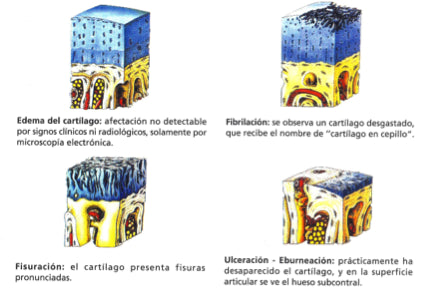
Stages of articular cartilage injury:

When cartilage destruction is generalized, we refer to chondromalacia, and if it is focal, we speak of osteochondritis.
However, there are other considerations to take into account regarding both entities. In chondromalacia, there is cartilage degeneration due to an alteration of the homeostatic balance of the cartilaginous tissue, whereas in osteochondritis, what usually happens is necrosis of the subchondral bone.
The symptoms usually include pain, joint effusion, clicking, joint stiffness, and even joint locking.
How can I protect my joints?
As a treatment, a fundamental goal is to restore the physiological conditions of the cartilage so that it can continue to function correctly. It is possible that the ideal way to treat these injuries is precisely to prevent them. We commonly take branched-chain amino acids, vitamins, minerals, whey protein isolates, etc., to help recover and regenerate our muscles after a hard workout, and we forget about our joints. We also have specialized products for joint protection.
Regarding scientific publications, we have several effective active ingredients to prevent articular degeneration.
Glucosamine Sulfate
Glucosamine is a natural component of healthy cartilage, bone matrix, and synovial fluid. Our body naturally produces glucosamine, and it is not possible to obtain it from our diet. At some point in our lives, we are unable to produce enough glucosamine, so it is beneficial to take it as a supplement to aid joint protection. Glucosamine stimulates articular cartilage cells (chondrocytes) to form proteoglycans and collagen, two proteins essential for proper joint function. Additionally, it prevents collagen from breaking down.
MSM (Methylsulfonylmethane)
MSM is a sulfur-containing compound and is a primary source of bioavailable sulfur. MSM promotes increased permeability of the cell wall, allowing water and nutrients to circulate inside the cell. Furthermore, it can facilitate the elimination of toxins from the cell. The practical benefit of this substance is that it provides great flexibility to articular cells (chondrocytes), thus keeping the joint more lubricated. It is one of the essential supplements for joint protection.
Chondroitin Sulfate
Chondroitin sulfate is part of the glycosaminoglycan group, which are important structural constituents of the cartilage's extracellular matrix. It is mainly present in tissues with a large extracellular matrix, such as those that form the body's connective tissues, cartilage, skin, blood vessels, as well as ligaments and tendons.
In degenerative joint diseases like osteoarthritis and other chondral pathologies, there is deterioration and loss of articular cartilage. A key phase during the degenerative process is the loss of cartilage proteoglycan and the mechanical malfunction of its collagen network.
Chondroitin sulfate is the main constituent of cartilage. It provides structure, retains water and nutrients, and allows other molecules to move through the cartilage. This last property is important because there is no blood supply to the cartilage.
The beneficial effects of chondroitin sulfate on nitric oxide (NO) synthesis have been demonstrated by researchers.
Bibliography
- Prevención de lesiones en el deporte. Claves para un rendimiento óptimo. D. Romero Rodríguez. J. Tous Fajardo. Ed. Panamericana 2010.
- Lesiones deportivas. Diagnóstico, tratamiento y rehabilitación. R. Bahr, S. Mæhlum. Ed. Panamericana. 2009.
- El deporte y la actividad física en el aparato locomotor. A. Herrera Rodríguez, G. Herrero-Beaumont, L. Ferrández Portal, A. Rodríguez de la Serna. Ed. Masson 2002.
- La anatomía de la lesiones deportivas. B. Walker. Ed. Paidotribo. 2010.
- Fisiología del ejercicio. J. López Chicharro. A. Fernández Vaquero. Ed. Panamericana, 3ª edición, 2006.
- Lippiello L, Woodward J, Karpman R, et al. In vivo chondroprotection and metabolic synergy of glucosamine and chondroitin sulfate. Clin Orthop. 2000;(381):229 – 240.
- Lippiello L, Karpman RR, Hammad T. Synergistic effect of glucosamine HCL and chondroitin sulfate on in vitro proteoglycan synthesis by bovine chondrocytes. Presented at: American Academy of Orthopaedic Surgeons 67th Annual Meeting; March 15 – 19, 2000.
- Adebowale AO, Cox DS, Liang Z, et al. Analysis of glucosamine and chondroitin sulfate content in marketed products and the Caco-2 permeability of chondroitin sulfate raw materials. J Am Nutraceutical Assoc. 2000;3:37 – 44.
- Bucsi L, Poor G. Efficacy and tolerability of oral chondroitin sulfate as a symptomatic slow-acting drug for osteoarthritis (SYSADOA) in the treatment of knee osteoarthritis. Osteoarthritis Cartilage. 1998;6(suppl A):31 – 36.
- Conrozier T. Anti-arthrosis treatments: efficacy and tolerance of chondroitin sulfates (CS 4&6) [translated from French]. Presse Med. 1998;27:1862 – 1865.
- Uebelhart D, Thonar EJ, Delmas PD, et al. Effects of oral chondroitin sulfate on the progression of knee osteoarthritis: a pilot study. Osteoarthritis Cartilage. 1998;6(suppl A):39 – 46.
- Thie NM, Prasad NG, Major PW. Evaluation of glucosamine sulfate compared to ibuprofen for the treatment of temporomandibular joint osteoarthritis: a randomized double blind controlled 3 month clinical trial. J Rheumatol. 2001;28:1347 -1355.

Compartir:
Delicious protein-filled dates
Protein Fitness Muffins