

Currently, when talking about sports supplements, the most popular among athletes in many disciplines are protein powders. These are used to supplement and meet the requirements of this macronutrient to help maintain or increase muscle mass, facilitate the consumption of the necessary daily dose, and also take advantage of any additional beneficial impact offered by protein or nutrient consumption. But, when it comes to choosing, which one should we opt for? Let's look at the differences between concentrated and isolated protein.
THE TECHNOLOGY BEHIND YOUR PROTEIN SHAKE
Advances in food processing technology have enabled the isolation of high-quality proteins from both animal and plant sources. The most common types of protein found in these types of supplements are whey, casein, soy, and egg proteins. All of them are classified as complete proteins and considered high-quality proteins.
However, more and more research is accumulating, demonstrating that whey proteins promote effective recovery, strengthen the immunization process, and as numerous clinical trials show, directly improve athletic performance.
Whey protein
Compared to other types of protein, whey protein shows a high digestion rate, which translates into increased amino acid levels and a significant increase in Muscle Protein Synthesis (the way muscle mass develops). It generally contains higher doses of essential amino acids (especially branched-chain amino acids or BCAAs: leucine, isoleucine, and valine) than other protein sources and exhibits multiple bioactive fractions that can help the immune system, provide antioxidants, and other health-related attributes. Additionally, whey protein is highly soluble and can be easily diluted in any liquid.
The role of Leucine
Although the overall proportion of all essential amino acids is important, the high concentration of leucine in whey protein, which is around 10-14%, is of particular interest to sports scientists, due to its ability to favorably promote muscle activation and growth. Recent studies confirm that leucine plays an important role within muscle DNA for protein synthesis. The abundant supply of leucine to the muscle after exercise can promote more effective molecular recovery and accelerate the training adaptation process. Furthermore, whey protein exhibits high concentrations of the amino acid cysteine (a powerful antioxidant), as well as a mixture of immunoglobulins, "growth factors" that not only promote muscle development, and other fractions (lactoferrin and lactoperoxidase) that can confer additional benefits.
Whey proteins are commercially available as concentrated, isolated, or hydrolyzed whey protein. The technology behind each type of whey determines its composition, characteristics, and effectiveness. The main differences between them are the processing method and minor differences in fat content, carbohydrates (lactose), and amino acid profiles.
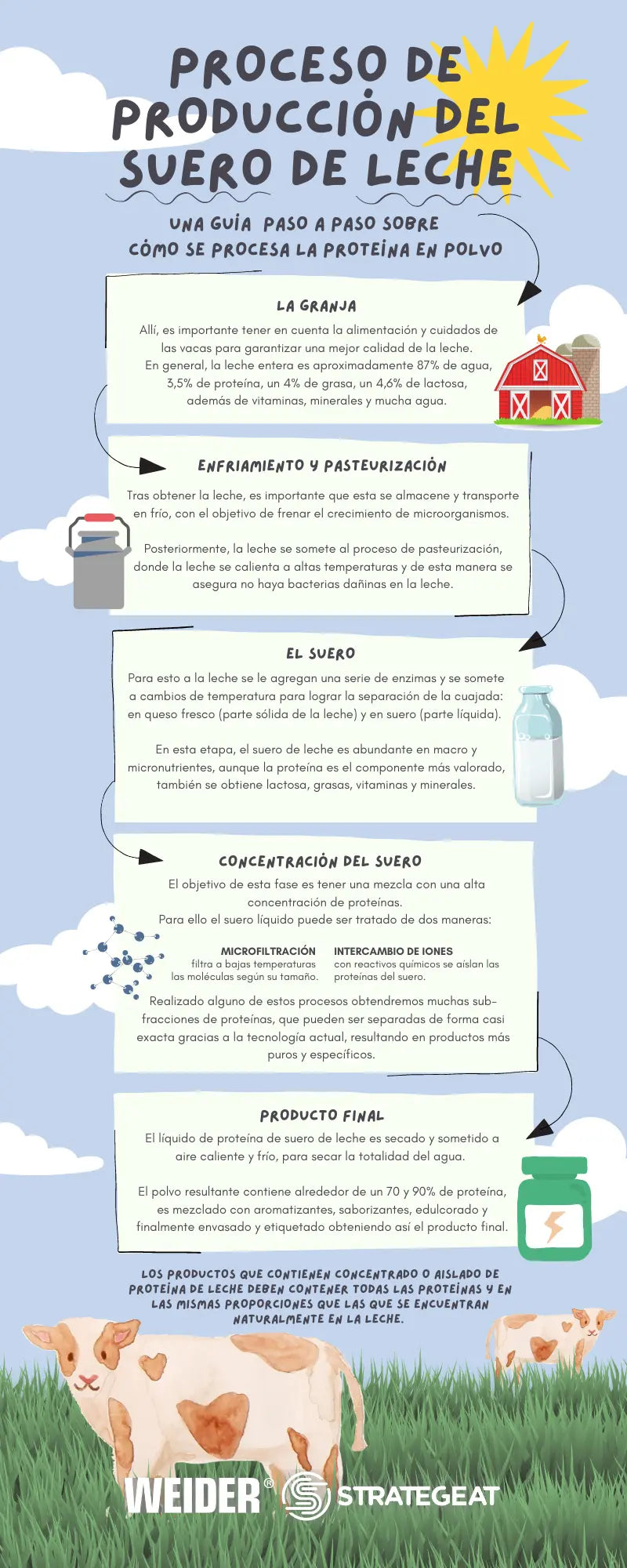
Generally, the whey production process is as follows:

Differences between concentrated and isolated protein
Protein Quantity
Research suggests that protein concentrate (WHEY CLEAN) and protein isolate (ISOLATE WHEY) meet the requirements of individuals who exercise regularly. Generally, a protein concentrate will have between 34% and 89% protein, meaning it will have 34-89g of protein per 100 total grams. Whey protein isolates, on the other hand, have about 90% protein. The remaining percentages correspond to the fat and carbohydrate (lactose) content.
Biological activity
Another major difference between these two types of whey proteins is their biological activity (the positive or negative effects on human body cells), where processing techniques are decisive. If these processes are carried out at low temperatures and avoiding excessive acidity, the product will offer its active biological effects. Research has found that whey proteins that maintain their structure (undenatured) can support the immune system, enhance muscle development, and show certain anticancer properties.
Extraction process
Not all whey concentrates or isolates are processed in the same way and therefore can be very different. As we show in the diagram, there are two technologies for their processing: Ion Exchange and Microfiltration.
Ion exchange provides a higher concentration of protein, however, during this process most of the bioactive components that give extra value to whey protein are disintegrated or completely lose their biological capacity. In other words, it's sacrificing one thing for another, which is not the idea.
Meanwhile, microfiltration produces a slightly lower protein level, but it does not denature it, maintaining its biological activity. It is a mechanical process that does not chemically damage bioactive substances, where with each step, successive filter membranes remove fat and lactose. The process is carried out at low temperatures, isolating the protein in a natural way and maintaining its initial pH, thereby preserving its components and keeping the concentration of molecules and other components with a positive effect on the immune system almost intact. This allows for a superior amino acid and protein profile, with the optimal and original balance of whey, with proteins in their natural structure that are easily assimilable, with more calcium and less sodium.
With milk from grass-fed cows
This latter is the type of processing used for the production of the 100% WHEY CLEAN and ISOLATE WHEY 100 CFM formulas. Here, fresh milk from grass-fed cows is used as premium raw material, which means the nutrient profile is very different from conventional concentrated or isolated milk proteins.
In both formulas, the nutrients remain intact during processing; the proteins do not undergo any denaturation, thus maintaining a very rich profile of branched-chain amino acids (BCAAs).
Digestibility level
While whey proteins are characterized by their easy digestibility and very low lactose content, in the cases of concentrated protein 100% WHEY CLEAN and isolated protein ISOLATE WHEY 100 CFM, we find added enzymes with the aim of promoting digestive and intestinal absorption processes.
For its part, concentrated protein 100% WHEY CLEAN includes the added enzyme Lactase, which is responsible for enabling lactose digestion. Unlike ISOLATE WHEY 100 CFM, which includes a patented combination of digestive enzymes (Digezyme®), that help in the digestion and breakdown of protein, fat, and carbohydrate molecules into smaller structures, facilitating digestive processes and maintaining gastrointestinal health.
Conclusion
It is as important to include these types of supplements in our diet as it is to be able to understand the different strategies that nutrition provides us for recovery and improvement of our performance. Choosing between concentrated or isolated protein will depend on specific factors for each athlete, whether due to the type of training they do, the goal they pursue, or even their ability to adapt training and diet to their regular routine. Each individual has characteristics that differentiate them from others, so never forget the importance of consulting a specialist who can guide and advise you so that you can use these types of supplements in the most beneficial way for you.

Compartir:
What supplements should I take to gain muscle mass?
Can you gain muscle mass with vegan protein?