

Muscles are the basic structure of the locomotor system, and training them is the goal for achieving maximum performance. However, programmed and continuous training can lead to injuries or significant exhaustion, preventing us from achieving the desired performance. If we play sports regularly, we should pay attention to muscle protection.
How do our muscles work?
Muscle growth requires three aspects: stimulus (exercise), fuel (energy), and repair (proteins and amino acids). But let's explain what a muscle is, how it adapts to exercise, and how to prevent injuries.
STRUCTURE AND FUNCTION
Muscles make up 40% to 45% of body mass.

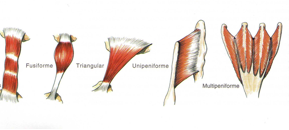
The muscular structure reflects its main function: power generation. The muscle fiber represents the basic macroscopic functional unit of the muscle, organized in different ways, forming unipennate, multipennate, or fusiform patterns (Figure-1).
Pennate muscles are usually stronger than fusiform muscles because several muscle fibers work in parallel. However, since pennate muscles contain short fibers, their maximum contraction speed is lower than that of fusiform muscles. The primary subcellular element of muscle is the myofibril, which is composed of protein filaments, mainly actin and myosin. The fibers are surrounded by capillaries (Figure-2), meaning the ability to supply oxygen and nutrients to the muscle is very good.

The ability of muscles to generate power depends on working conditions. When force is generated without changing the joint angle, the muscle action is called isometric or static. Concentric muscle action refers to power generation during muscle shortening, while the term eccentric action applies to a muscle that lengthens while generating force. During concentric action, maximum force generation decreases as contraction speed increases, while during eccentric muscle activity, muscle force increases with increasing speed. Consequently, the risk of muscle injuries is greater during eccentric activation than during concentric muscle action.
ADAPTATION TO TRAINING
Muscle is the soft tissue that exhibits the most significant and rapid response to training. Muscle volume and strength increase significantly after a short period of specific strength training. Two factors contribute to this type of strength increase:
The increase in muscle volume is mainly due to the increase in the cross-sectional area of individual muscle fibers (hypertrophy), but also to the formation of new muscle cells (hyperplasia) derived from pluripotent cells called satellite cells, located at the periphery of the myofibrils. Neural factors primarily influence the initial increase in strength that occurs in response to training, while hypertrophy is the main cause of subsequent increases.
Muscle strength increases after a few weeks of training, but tendons, cartilage, and bone require several months of adaptation; this implies the risk of developing overuse injuries once systematic strength and jumping training has begun. The patellar and Achilles tendons are particularly vulnerable to these overuse injuries observed in adult athletes.
INJURIES AND PREVENTION
MUSCLE INJURIES
Muscle injuries are generally caused by two mechanisms: strain (stretching) and direct trauma causing muscle contusion. Tears (lacerations) can also occur. Furthermore, muscle injuries often result from particularly difficult and unusual training, especially eccentric type, which can cause delayed onset muscle soreness. Muscle strains usually occur at the musculotendinous junction during an episode of maximum eccentric muscle activity. Sprinters are particularly prone to this type of injury. The most commonly affected muscles are the hamstrings, hip adductor, and gastrocnemius.
However, many muscle groups can suffer strains. The athlete feels sudden pain at the moment of injury. Then tenderness persists, and a significant decrease in contractile function is added; sometimes, when there is a significant tissue tear, the individual may notice a bulge in the muscle immediately after the injury. Another characteristic sign is swelling secondary to bleeding or subsequent edema.
The quadriceps muscles are located in the front and side of the thigh and are therefore more frequently exposed to contusions from trauma. All types of muscle injuries, regardless of the cause, are associated with internal muscle bleeding. This happens because the muscular system is highly vascularized and because regional blood flow is usually high at the time of injury. Bleeding is intramuscular when there is no injury to the muscle fascia, or intermuscular when it is associated with fascia trauma and blood can escape from the affected muscle compartments. In general, healing time is significantly longer in the presence of intramuscular bleeding than in the case of intermuscular hemorrhage.
Tissue injury and bleeding cause an inflammatory reaction; this inflammatory reaction forms the basis of the repair response leading to scar tissue formation. After a significant muscle injury, muscle tissue regeneration is minimal, and the injured tissue is instead replaced by fibrous scar tissue that lacks contractile properties, increasing the risk of recurrent injuries.
Occasionally, muscle hematomas can cause a complication known as ossifying myositis, characterized by calcifications or ossification in the injured tissue. The most common location for ossifying myositis is the thigh. Almost 20% of athletes who suffer quadriceps contusions develop ossifying myositis. Not all of these patients are symptomatic, even though hematoma calcification may be visible on X-rays.
Muscle stiffness (delayed onset muscle soreness) is an annoying but generally harmless symptom that appears after unaccustomed muscle exercise for the athlete. The pain usually appears after intensive eccentric training. Symptoms usually increase gradually during the hours following training, peak at approximately 48 hours, and disappear within the following 2 to 5 days. Delayed muscle soreness is secondary to the disruption of skeletal muscle architecture and is accompanied by a discrete, temporary restructuring (10-15%) of muscle strength. This type of muscle soreness usually only appears after the first few times a new eccentric exercise is performed. Stretching does not seem to prevent delayed muscle soreness.
PREVENTION OF MUSCLE INJURIES
First and most importantly, have a correct training plan, designed by an appropriate coach, and it doesn't matter if it's strength or endurance training; the training should be guided by a professional in the field.
It is essential to carry out complete training sessions, where stretching will play a very important role not only in preventing muscle injuries but also in preventing tendon injuries, etc.
Allow for regulated rest periods. It's not only important to train a lot; resting a lot is also important. It is vital for the muscle to regenerate and recover from the effort it undergoes during training. If this were not the case, when working with this muscle again, it would eventually become fatigued and have a high probability of injury. It is also essential to get adequate nocturnal rest, as this is when the muscle regenerates best.
Sports performance is based on three pillars: Training, Nutrition, and Rest. Once the foundations of two of the pillars have been established, it's time to delve into the world of nutrition and nutritional supplementation.
Of the immediate principles, such as proteins, lipids, and carbohydrates, we should not forget any. Their proportion may vary depending on the time of the season we are in, as it will not be the same in the preseason as at the time of our main competitive goal.
Continued and/or strenuous aerobic exercise leads to alterations in skeletal muscle, ranging from inflammation to necrosis (cell death). It may be advisable to have periodic blood tests with certain parameters that can determine muscle damage due to training (CPK, LDH, GOT, muscle aldolase, etc.). If the muscle inflammatory process persists over time and can occur as a consequence of not respecting the rest phases, it can lead to rhabdomyolysis (death of muscle cells). Some interesting supplements could be:
- Proteins: a nitrogen-rich molecule that is part of the immediate principles, composed of a long chain of amino acids. Protein provides amino acid building blocks for muscle construction and its high nitrogen content creates the appropriate anabolic environment for muscle growth.
- Branched-chain amino acids: Supplementation with branched-chain amino acids 2 hours before cycling training at 70% of VO2 max has shown a smaller increase in post-exercise CPK and LDH, indicating less muscle damage. Leucine is the amino acid precursor for protein synthesis in muscle regeneration. The recommended dose of branched-chain amino acids is 12 g/day in two-week cycles.
- Glutamine: an amino acid with very interesting effects. On the one hand, after exercise, there is a temporary decrease in the body's defense mechanisms, and we are more exposed to infectious processes. In this sense, it improves lymphocytic capacity. On the other hand, it increases the absorption of branched-chain amino acids and promotes the secretion of growth hormone (which is why it is recommended to take it at night to help the circadian rhythm of this hormone). The recommended dose can vary between 1g-5g/day in 3-week cycles.
- Creatine: a great classic in sports supplementation. This molecule is related to an increase in protein synthesis, specifically myosin, it attenuates muscle degradation, increases nitrogen supply, promotes muscle hypertrophy, and improves muscle strength. The recommended dosage will be an initial overload of 20g/day for 5 days and then continuing with maintenance doses of 2-4 g/day.
- Beta-Hydroxy-Methylbutyrate (HMB): a leucine metabolite that decreases muscle degradation caused by exercise. It is advisable to take it with calcium during resistance exercises, decreasing the percentage of fat and markers of muscle catabolism. Furthermore, it can increase strength and lean mass.
- Magnesium: a fundamental trace element in the body that participates in more than 250 enzymatic reactions. It is involved in the repair and maintenance of body tissue cells as a cofactor in protein metabolism. It is essential for nerve impulse transmission. It acts in all reactions involving ATP (energy molecule) and therefore in the synthesis of proteins, nucleic acids, and nucleotides. It is a fundamental element in muscle tissue as it is involved in the muscle contraction process, and its use is essential as a relaxant. It should be used at night at a recommended dose of 200-350 mg/day. We can use products in capsules or liquid (vials), with the latter being more effective.
Bibliographical references:
- Nutritional management and other therapeutic measures in sports practice and competition. J.G. Villa Vicente and F.J. Navas Cámara, Medicine 2002; 8(85):4577-4586.
- Diagnostic protocol for hepatic alterations associated with physical exercise. P. Sánchez Collado and J. González Gallego. Medicine 2002; 8(85):4609-4610.
- Injury prevention in sports. Keys to optimal performance. D. Romero Rodríguez. J. Tous Fajardo. Ed. Panamericana 2010.
- Sports injuries. Diagnosis, treatment and rehabilitation. R. Bahr, S. Mæhlum. Ed. Panamericana. 2009.
- Sport and physical activity in the locomotor system. A. Herrera Rodríguez, G. Herrero-Beaumont, L. Ferrández Portal, A. Rodríguez de la Serna. Ed. Masson 2002.
- The anatomy of sports injuries. B. Walker. Ed. Paidotribo. 2010.
- Exercise physiology. J. López Chicharro. A. Fernández Vaquero. Ed. Panamericana, 3rd edition, 2006.
- Sports nutrition. A practical approach. L. Burke. Ed Panamericana. 2009.
- Weight training programs. N Evans. Ed. Tutor. 2011.

Compartir:
The egg
Energizing Pre-Workout Smoothie